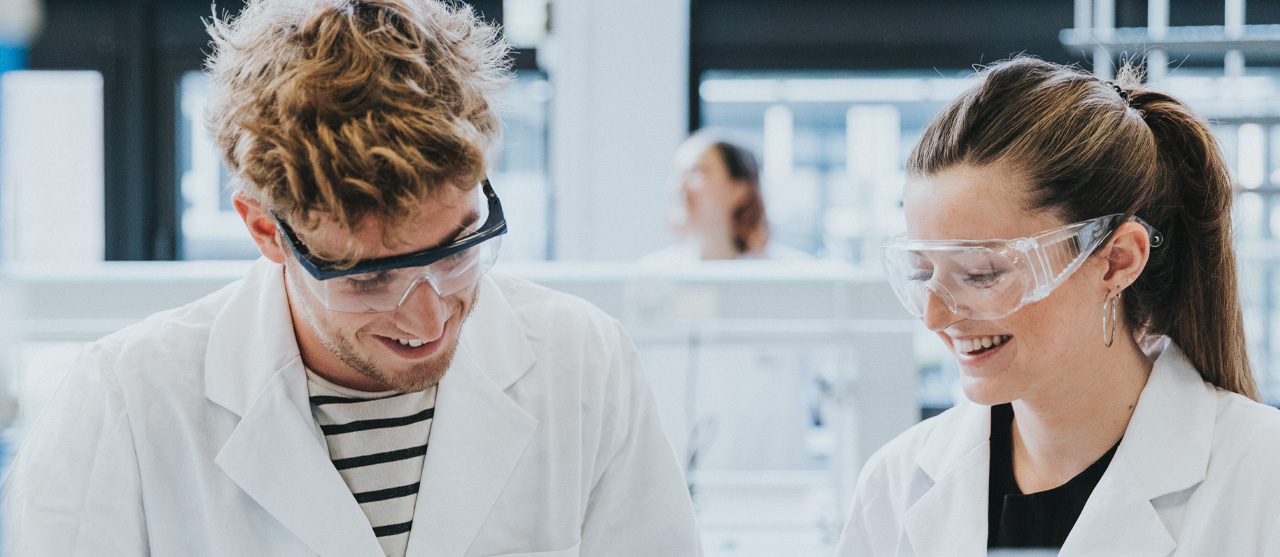
The new international exchange programme in chemistry combines theoretical courses with practicals and internships. Depending on your interests and background, you can choose between several modules: Chemistry, Biochemistry: intermediate, Biochemistry: advanced or Environmental technology.
The industrial internships contain project work in collaboration with one of Belgium's chemical companies or research institutes.
Practical info
Autumn semester
- Welcome days: 18 September 2026
- Start programme: 21 September 2026
- Start of the exams: 4 january 2027
- End of the exams: 25 January 2027
Questions about the content of the program?
Contact your International Academic Coordinator: sofie.vanholle@hogent.be
Practical questions?
Contact your Incoming Student Advisor: incoming@hogent.be
Check the courses of the programme below. More detailed information available in the study guide.
Chemistry
Conducting experiments in one of Belgium's chemical companies or research institutes.
Practicals combining sample preparation, separation, and analysis techniques! Learn liquid-liquid and solid-liquid extraction, master chromatography methods (TLC, GC, HPLC), and identify compounds using UV/VIS, IR, and flame photometry. Perfect your precision with volumetric techniques for accurate quantitative analysis.
Theoretical course exploring sustainable and green chemistry concepts! Dive into sustainability, biobased economy, LCA, the 12 principles of green chemistry and biorefinery processes including bioreactors and downstream processing. Discover emerging innovations such as biosurfactants, microalgae, carbon dioxide utilization, and circular plastics.
Biochemistry: intermediate
Conducting experiments in one of Belgium's chemical companies or research institutes.
Practicals combining sample preparation, separation, and analysis techniques! Learn liquid-liquid and solid-liquid extraction, master chromatography methods (TLC, GC, HPLC), and identify compounds using UV/VIS, IR, and flame photometry. Perfect your precision with volumetric techniques for accurate quantitative analysis.
Theoretical course diving into molecular analysis technologies! Explore in vitro enzyme applications, genome analysis and sequencing. Learn more about the recombinant DNA technology — from traditional cloning, PCR cloning to LIC and recombinational cloning. Gain insights into bioinformatics and its role in modern molecular research.
Biochemistry: advanced
Theoretical course diving into molecular analysis technologies! Explore in vitro enzyme applications, genome analysis and sequencing. Learn more about the recombinant DNA technology — from traditional cloning, PCR cloning to LIC and recombinational cloning. Gain insights into bioinformatics and its role in modern molecular research.
Hands-on practical course using molecular biotechnology and immunological techniques! Isolate and analyze biomolecules like DNA and proteins, perform transformation, PCR, gel electrophoresis, restriction digest, protein purification, SDS-PAGE and/or ELISA. Gain insight into experimental design, bioinformatics tools (e.g., BLAST), and data processing to tackle biotechnological challenges.
Project-based practical on bioproduction and processing! Track the production of biocomponents in a fermentation process using biochemical analysis techniques, focusing on both quantitative and qualitative monitoring. Explore upstream and downstream processing strategies to optimize the workflow from start to finish.
Exploring career opportunities in the (bio)chemical field! Students independently research possibilities in chemical, biochemical, and environmental sectors through company visits, MOOCs, job shadowing, seminars, and more. This hands-on exploration bridges classroom knowledge with real-world insights.
Environmental Technology
Theoretical course on water treatment and purification! Explore drinking water production, water pollution parameters, and measurement technologies. Dive into primary, secondary, and tertiary wastewater treatment techniques, membrane processes, sludge management, and emerging trends in water technology.
Conducting experiments in one of Belgium's chemical companies or research institutes.
Practicals combining sample preparation, separation, and analysis techniques! Learn liquid-liquid and solid-liquid extraction, master chromatography methods (TLC, GC, HPLC), and identify compounds using UV/VIS, IR, and flame photometry. Perfect your precision with volumetric techniques for accurate quantitative analysis.
Optional Courses
Innovative Solutions Lab is an activity-based course that combines design thinking, entrepreneurship, and intercultural collaboration. This course is uniquely designed to work in close synergy with the Entrepreneurial Teams program, an interdisciplinary honors initiative where select student teams address real-world challenges over multiple years.
In this course, students form their own project teams to tackle sub-challenges defined by the Entrepreneurial Teams and their stakeholders. These sub-challenges are approached using a combination of design thinking methodologies and entrepreneurial principles, enabling students to develop innovative, user-centered solutions while enhancing their cultural adaptability, creativity, and self-directed learning skills.
The course begins with three foundational sessions introducing key concepts in design thinking, entrepreneurship, and collaborative teamwork. After this introduction, students take ownership of their projects, working more autonomously and interacting regularly with the Entrepreneurial Teams and their stakeholders. This dynamic collaboration provides students with real-world experience in addressing complex challenges within an international and interdisciplinary context.
The LoopMe app is employed throughout the course to support individual learning and reflection tasks. These tasks foster critical thinking, self-regulation, and the ability to link theoretical knowledge to practical problem-solving.
At the conclusion of the course, student teams present their solutions to the Entrepreneurial Teams and their stakeholders, showcasing their innovative approaches, entrepreneurial mindset, and ability to work in diverse, cross-cultural teams.
The course aims to help students evaluate the practicality and limitations of AI solutions within their field, understanding that AI is not a universal fix for every problem. Emphasis is placed on recognizing when traditional methods are more efficient, while also building foundational knowledge of AI concepts, data requirements, and common challenges like bias and privacy. Students learn key AI terms, project cost factors, error rate relevance, and model training phases, gaining skills to assess AI’s suitability for specific applications. They can analyze problem scenarios, identify suitable AI methods, and compare real-world project methodologies to theoretical approaches.
- Sustainability of the agri-food chain
- Valorisation of by-products and alternative energy
- Fashion & society
- CSR Strategy
- Innovative textiles