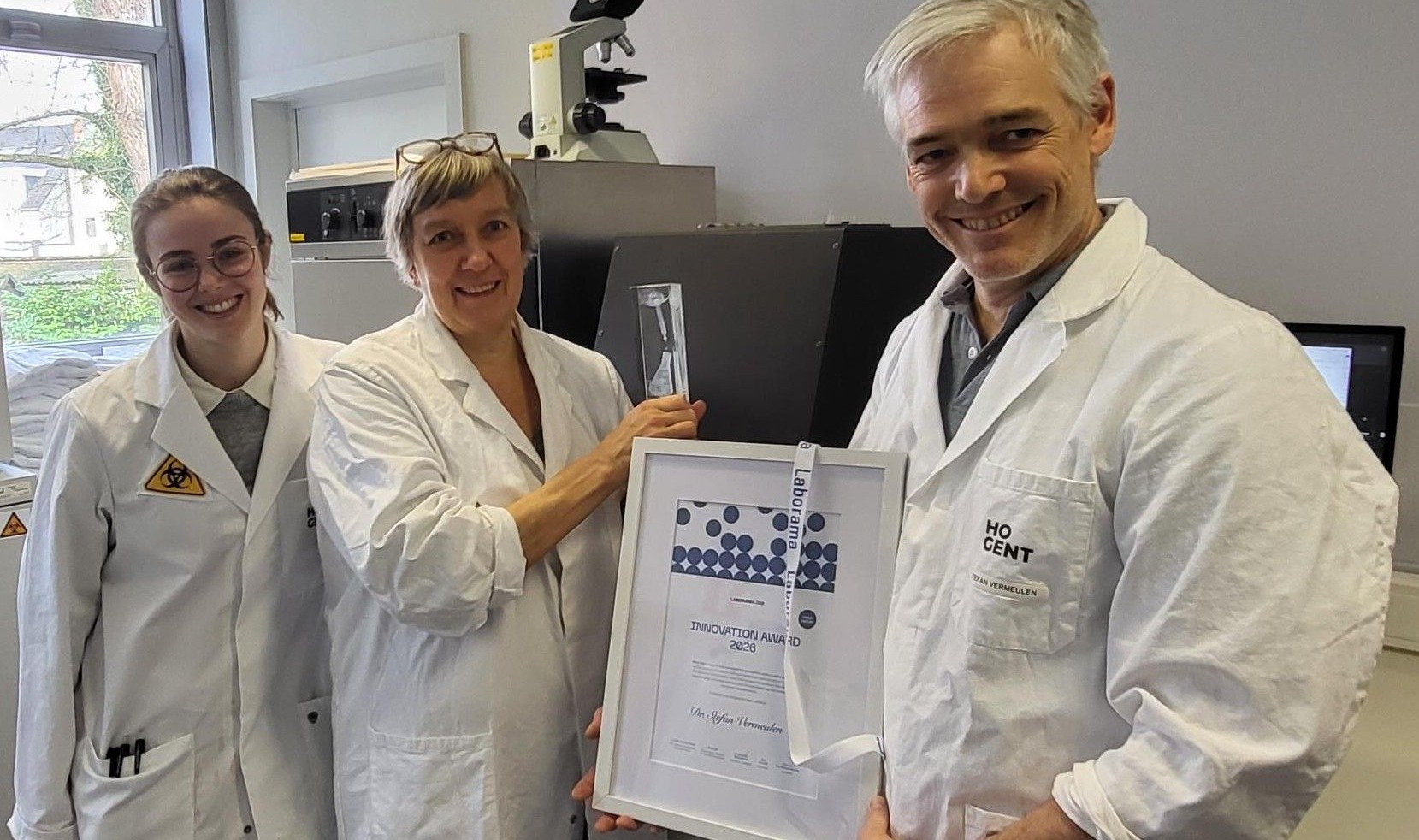
Researcher Stefan Vermeulen developed the PMD4U methodology together with Els Van Mechelen, Marjoke Le Roy and Anja Nuytten, all team members of the HOGENT research centre Health & Water Technology. The PMD4U methodology represents a significant step forward in the development of bacteriophage therapy and, indirectly, in the fight against antibiotic resistance. With an award and a substantial injection of project funding from the Industrial Research Fund (IOF) within a single week, there is no doubt that the project has garnered strong support.
The PMD4U was honored with the Laborama Innovation Award (Laborama is a leading trade fair for laboratory professionals). The project also obtained approval for the Stepstone Project, a key project support initiative aimed at developing application-oriented knowledge and technology and transferring it to the business community, the government, and the nonprofit sector. PMD4U has been awarded €580,000 in funding over a two-year period. This budget will primarily be used to further refine the developed device. This project support can be considered the final step toward a spin-off. The IOF business developer from Medical Technology Ghent (MedTeG) will provide strategic support for the project, and a so-called “entrepreneur in residence” will be recruited to focus on preparing for the spin-off during the final phase of the project (exploring the market, prospecting potential first customers, holding discussions with investors, etc.).
What are bacteriophages?
Bacteriophage therapy is a treatment for bacterial infections and serves as a natural alternative to antibiotics. Bacteriophages, or simply "phages", are the natural enemies of bacteria. They recognize and infect target bacteria, forcing the bacteria to produce new phages. Eventually, the bacteria burst open, releasing new phages into the environment to infect other bacteria, repeating the cycle.
Although phages have been known for over 100 years, they were pushed into the background by the rise of antibiotics. Because phages are biological entities, they are more difficult to apply on a large scale compared to traditional drugs.
"Producing antibiotics is actually quite easy and cheap: you can manufacture tons of them at once. But antibiotics are like shooting a cannon at a fly. Furthermore, they are toxic products that bacteria can adapt to, leading to resistance", explains Stefan Vermeulen.
This resistance has become a severe medical crisis. Estimates suggest that by 2050, AMR (Antimicrobial Resistance), could cause more deaths than cancer if efficient alternatives to antibiotics are not found. This rising resistance is now fueling a strong revival of interest in phage therapy.
Less labour-intensive
Currently, phages are commercialized as biological agents for disinfecting food and food-related environments, as well as for the targeted biological protection of crops.

“There was a need for a standardized process that increased the speed and precision of phage quantification while improving user-friendliness.”
Stefan Vermeulen, researcher research centre Health & Water Technology
Regardless of whether phages are used to protect humans, animals, or crops, accurately measuring the exact amount of the phage concentration during the production process is crucial. "You need a minimum number of phages to achieve an effect", Vermeulen clarifies. "The current methods for quantifying a phage stock are extremely labour-intensive. There was a clear need for a standardized process that increases speed and precision while improving user-friendliness."
With this goal in mind, the team developed an alternative system and device that is cheaper, less labour-intensive, less polluting and faster. They named it PMD4U, which stands for Phage Measurement Device for You.
Stefan Vermeulen hopes that the user-friendliness of the system will contribute to a 'marketization' of bacteriophage therapy, which could slow down antibiotic resistance. As a societal impact, that certainly counts.